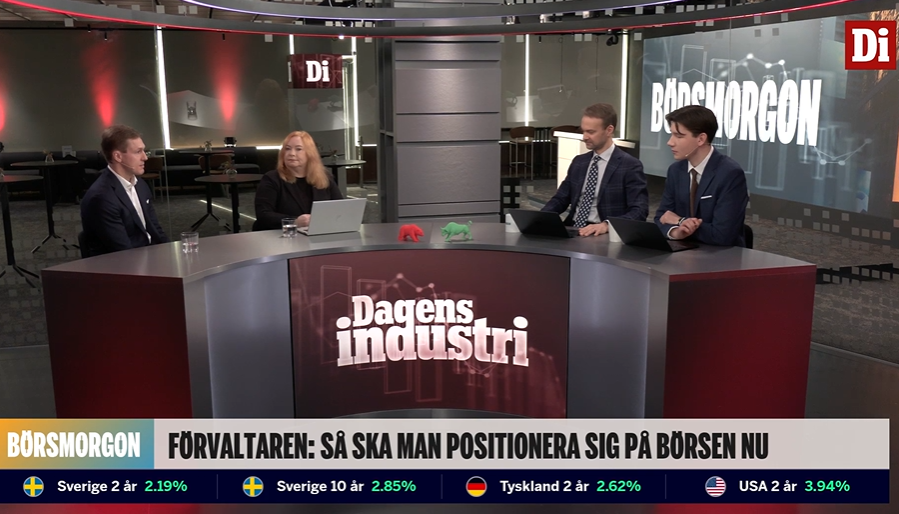
On Thursday morning, 26 March, our portfolio manager, partner and CEO Alexander Jansson once again appeared on DiTV’s Börsmorgon to share his views on the current market environment. The discussion centred on geopolitical uncertainty, structural shifts in the market, and why Europe now stands out as a compelling opportunity for investors.
Iran’s military in perspective
During the programme, Alexander offered his perspective on Iran’s military capacity in an economic context. Iran’s GDP is roughly half that of Sweden’s, and the country spends around 2% of GDP on defence — 2% of an already relatively small economy, pointing to a modest budget in both absolute and percentage terms. To put this in context, Alexander noted that the United States has a defence budget 140 times larger, Israel 7 times larger, and Saudi Arabia 11 times larger than Iran’s. In Alexander’s view, the numbers make it clear that the picture of overwhelming military superiority against Iran is unambiguous.
Geopolitics and the stock market — has the bottom been reached?
But what does geopolitical uncertainty actually mean for the equity market? Alexander highlighted data going back to the Second World War: on average, geopolitical events have had a limited and short-lived impact on the market. For the S&P 500, the bottom has on average been reached within 16-17 trading days, and the total drawdown has stayed at 6-8%. Given the magnitude and duration of the move we have seen this week, Alexander’s analysis suggests we should be at or near a market bottom.
Infrastructure and HALO — a trend that favours Europe
One of the more structural themes Alexander raised is infrastructure in a broad sense — related to AI, energy and defence, but also to the reconstruction of Ukraine and the Middle East. A clear trend known as HALO (Heavy Assets, Low Obsolescence) is emerging in the market, focusing on companies with heavy, hard-to-replace assets while avoiding software companies. Examples of well-positioned companies within this theme were highlighted during the broadcast. This trend favours Europe over the US, as Europe has a heavier industrial base whereas the US is dominated by software companies — a composition that is now facing increasingly strong headwinds.
Europe outperforming the US — a historic shift
Since the end of November 2024, Europe has outperformed the US by a full 24% over 15 months. This is both the largest and the longest period of European outperformance relative to the US in 17 years — and for the first time, Europe has broken out of the underperformance channel that has held since 2007. It is a trend reversal that Alexander believes deserves attention from investors who have long focused exclusively on the US.
Rotation away from the Magnificent 7 in the US
In the US, there are signs that the big tech giants — the Magnificent 7 — are no longer the undisputed engine of the market. Value stocks have begun to outperform growth stocks, and small- and mid-cap companies have started to regain ground against the large caps. Taken together, this suggests that the extreme valuation expansion and concentration built up around a handful of software companies is now being challenged by a broader rotation in the market.
Watch Börsmorgon here.
Investments always involve risk. Unit prices may rise or fall in value, and investments are always associated with a risk of loss. Past performance is never a guarantee of future returns. This is not investment advice.

Contact
CB Fonder
Strandvägen 5B
SE-114 51 Stockholm
SWEDEN
info@cbfonder.se
+46 (0)8 566 133 10
Responsible for the handling of complaints:
Alexander Jansson